

AI Chatbot for Med Spas: A Buyer Guide and 14-Day Pilot

An AI chatbot for a med spa should answer approved administrative questions, move suitable inquiries toward a real booking or lead-capture path, and transfer sensitive or uncertain conversations to a named person. It should not diagnose, recommend a treatment for an individual, interpret symptoms, invent an appointment time, promise an outcome, or improvise a policy.
That direct definition is the best starting point for a purchase decision. A chatbot is not useful because it can continue a conversation indefinitely. It is useful when it completes a bounded job with current information and leaves a trace that staff can review.
For most clinics, the first pilot should cover a narrow set of repetitive questions: location, hours, general service categories, published price information, consultation options, booking links, rescheduling rules, and how to reach a person. Expand only after the clinic can prove that answers, booking actions, consent, records, and escalations work together.
What is a med spa AI chatbot?
A med spa AI chatbot is a conversational interface that classifies an inquiry, retrieves an approved answer or action, and responds through a website or messaging channel. “AI receptionist” is often used for a broader system that may also answer calls, qualify leads, schedule appointments, send follow-ups, or route staff tasks.
Those labels do not prove what a product can do. During evaluation, replace feature names with observable tests:
Can it use only the clinic's approved information?
Can it distinguish a general administrative question from a personal clinical question?
Can it send a person to current availability without inventing a slot?
Can it capture a lead when direct booking is not appropriate?
Can it transfer the transcript and reason for escalation to the right queue?
Can staff correct an answer and see which conversations used the old version?
Can the clinic export records and remove access when a vendor relationship ends?
The answer may be a website chatbot, a messaging assistant, live chat with AI drafting, a structured form, or a combination. Start with the customer job, not the label.
Decide whether a chatbot is the right response model
Not every repetitive question needs generative AI. Compare five response models before buying.
Static answers
A clear service, pricing, policy, or location page is the lowest-complexity answer when the question has one public response. It is crawlable, reviewable, and available without requiring a visitor to open a chat. Improve the page before automating around missing content.
Structured lead form
A form is appropriate when the clinic needs a small set of fields and a human must review the request. The med spa lead form template explains how to ask only for information needed to route the next step. A form is less conversational, but it can be more predictable than a chatbot for consultation requests.
Rules-based chat
Buttons and decision trees work when choices are stable and limited: book, change an appointment, view prices, check hours, or contact staff. Rules are easier to audit, although a long tree can frustrate people whose question does not match the menu.
AI chatbot
An AI chatbot can help when people express the same intent in varied language and the clinic has enough approved source material to support a bounded answer. Its value is interpretation and routing, not permission to invent.
Human live chat or callback
Use a person when the conversation depends on judgment, empathy, an exception, a complaint, or individual health information. A chatbot can collect a callback preference, but it should not imitate clinical judgment.
Many clinics need a layered model: visible answers for common questions, a form or booking page for the next action, AI for language variation, and a human for exceptions.
Define the allowed and prohibited jobs
Write two lists before requesting a demo. The allowed list might include:
state published hours, address, parking, and contact details;
describe service categories using approved language;
explain that suitability requires an appropriate consultation;
share a published price, range, or price factor exactly as approved;
link to current consultation or booking availability;
explain published deposit, cancellation, and rescheduling policies;
capture name, contact preference, service interest, and requested next step; and
create a staff task with the reason and transcript.
The prohibited list should include:
diagnosing a condition or interpreting a symptom;
recommending a treatment for a particular person;
answering questions about complications, medications, pregnancy, contraindications, or urgency beyond approved escalation language;
inventing availability, price, credentials, reviews, outcomes, or policy exceptions;
taking an irreversible action without clear confirmation;
concealing that the visitor is interacting with automation; and
continuing after an opt-out or explicit request for a person.
These are operating recommendations, not a substitute for clinical, privacy, security, or legal review. A non-medical salon may draw different boundaries, but it still needs accurate answers and a reliable human path.
Build a five-action permission matrix

Define permitted actions before comparing vendors; an unowned escalation is not a completed workflow.
Give the chatbot only five classes of action during the first pilot.
Answer: Return an approved public fact and show the relevant next step.
Clarify: Ask one limited question needed to route the inquiry, such as location or whether the person wants a consultation.
Book: Open a current booking experience or offer slots only when the system has authoritative availability and the clinic has approved that action.
Capture: Create a lead for staff review when direct booking is not suitable.
Escalate: Stop the automated path, tell the person what will happen, and send the conversation to an owned queue.
Map every supported intent to one of those actions. If an intent has no approved action, the default is escalation—not improvisation.
Create a governed source of truth
A chatbot cannot stay accurate when clinic information is scattered across an old website, a staff document, social profiles, and individual memory. Build a compact answer library with:
question or intent;
approved response;
permitted action;
source URL or internal policy;
owner;
approval date;
next review date;
escalation trigger; and
version status.
Separate stable facts from changing facts. An address may change rarely. Availability, prices, promotions, providers, and policies may change often. The chatbot should retrieve the current value or point to the current booking or policy page instead of memorizing a temporary value.
Test what happens when a source conflicts with another source. A safe product should not silently choose the more persuasive answer. It should use a defined priority or escalate the conflict.
Test the full inquiry-to-booking workflow
A fluent reply can hide a broken business process. Test the journey from the first question through the system of record.
Use at least these scenarios:
A visitor asks for Saturday availability for a named service.
A visitor asks a general price question and then requests a consultation.
A visitor asks whether a treatment is appropriate during pregnancy.
A current client asks to change an appointment.
A visitor asks for a policy exception.
A person types a misspelled service name or uses a local nickname.
A visitor asks two questions in one message.
A person requests a human immediately.
A person withdraws consent or asks the clinic to stop messaging.
A visitor reports a possible adverse reaction.
For each scenario, record the expected answer, action, data created, notification, owner, and stop condition. The med spa booking flow audit can help verify that the destination itself is usable once the chatbot sends someone there.
Require a real human handoff
A handoff is not successful when the chatbot merely says that someone will reply. A complete handoff includes:
the queue, role, or named owner receiving it;
the reason for escalation;
the relevant transcript and permitted contact details;
the expected response window;
the channel staff will use;
a visible status such as open, assigned, resolved, or reopened; and
a fallback when the primary owner is unavailable.
Test alerts after hours, on weekends, and when a staff member is absent. Confirm that duplicate tasks are not created when the visitor repeats a message. Confirm that automation pauses when a human takes ownership.
For medical or urgent language, use clinic-approved instructions. A chatbot is not an emergency service. It must not create the impression that an automated response is clinical triage.
Ask vendors to demonstrate failure behavior
Do not spend the entire demo on the happy path. Ask the vendor to show what the system does when:
the answer is absent from the approved source;
two sources conflict;
the visitor requests a discount that is not authorized;
a booking integration is unavailable;
the model confidence is low;
a message contains sensitive information;
an administrator removes a staff member's access;
a source answer is corrected after conversations already occurred; and
the clinic needs to export conversation and audit records.
NIST's AI Risk Management Framework and Generative AI Profile emphasize risk management across design, use, measurement, and governance. For a clinic buyer, that means evaluating the surrounding workflow and controls, not treating a polished response as proof of reliability.
Ask for written answers about data retention, training use, subprocessors, access controls, incident notification, deletion, portability, availability commitments, and contract termination. If protected health information may be involved and the clinic is a HIPAA covered entity or business associate, obtain qualified review of the data flow and contractual requirements. Do not assume a “HIPAA-ready” badge settles the question.
Measure outcomes without inventing ROI
Choose measures the clinic can actually observe:
inquiries offered an approved answer;
correct-answer rate in reviewed samples;
booking-page visits from chat;
completed bookings attributable to the chat path;
leads created with sufficient routing information;
median staff response time after escalation;
unresolved or abandoned conversations;
corrections required;
opt-outs and complaints; and
prohibited-answer incidents.
Do not claim revenue or staff-time savings before the clinic has a baseline and a reliable attribution method. A chatbot may move work rather than remove it; staff could spend more time correcting bad captures or reviewing low-quality escalations.
Set a stop threshold. One serious prohibited answer may justify pausing the pilot even if booking completion looks strong.
Watch for six buying red flags
Pause the evaluation when a vendor cannot show the operational evidence behind a claim. Common red flags include a demo that uses only prepared questions, a promise that the model “never hallucinates,” no way to identify the source used for an answer, no separate record for staff escalations, unclear use of clinic conversations for model training, or a contract that makes export and deletion difficult.
Also question a product that treats every handoff as a failure. A safe system should escalate by design when the question exceeds its authority. A rising handoff rate may reveal missing approved content, a confusing service menu, or a poorly chosen automation scope; it is not automatically evidence that staff should be removed from the loop.
Ask the vendor to distinguish current capability, configurable capability, custom work, integration dependency, and roadmap. Record the product version and date demonstrated. If a result depends on an integration, test the integration's failure state as part of the same decision rather than scoring the chatbot in isolation.
Run a 14-day pilot before a broad launch
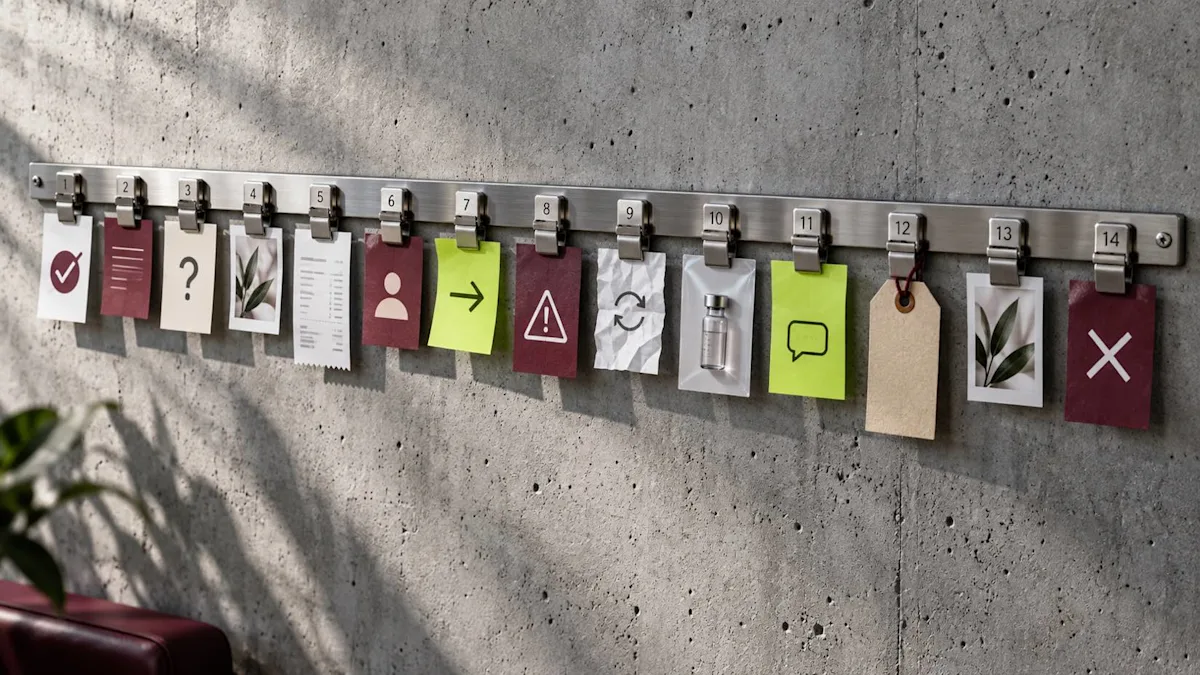
A pilot should preserve evidence for correct answers, completed bookings, staff handoffs, failures, and corrections.
Days 1–3: approve scope and evidence
Select five to ten high-frequency administrative intents. Approve answers, actions, owners, and escalation language. Remove any intent without a trustworthy source or staff owner.
Days 4–6: run scripted tests
Test normal wording, slang, spelling errors, compound questions, requests for a person, and prohibited topics. Include staff from operations, reception, marketing, and appropriate clinical or compliance roles.
Days 7–10: use a controlled audience
Expose the assistant to limited traffic, hours, locations, or service categories. Review a sample every day. Correct the source rather than patching one reply when the underlying answer is wrong.
Days 11–13: test exceptions
Temporarily remove a source, interrupt the booking connection, change a policy, and route an escalation to a backup owner. Verify that the system fails safely.
Day 14: make a gate decision
Approve, extend, narrow, or stop the pilot. Record evidence for each decision. Expansion should require passing results for answer accuracy, prohibited-topic behavior, booking integrity, handoff ownership, privacy and security review, accessibility, and record export.
Where Workee fits—and where it does not
Workee's public September 2026 product update documents Lead Forms that collect contact information and service interests, capture consultation or general inquiries, and create a lead for staff review. Workee also publicly documents booking and scheduling, client records, payments, and appointment activity.
Those capabilities can provide destinations and records around a chatbot: the assistant may link to a current booking page or direct a not-ready-to-book visitor to an approved lead form. The clinic can then evaluate whether the captured inquiry reaches its staff workflow.
This article does not claim that Workee currently provides the chatbot being evaluated. Verify any chatbot, voice, messaging, or integration capability in the product and contract before purchase. For channel-specific WhatsApp policy and implementation detail, use the separate AI WhatsApp booking workflow. For broader AI capability evaluation, see the med spa AI features buyer guide and the automation-versus-human decision guide.
A final buyer checklist
Before approving a med spa chatbot, confirm that:
its allowed and prohibited jobs are written;
every answer has an approved source and owner;
changing facts come from a current system or page;
booking never relies on invented availability;
a lead capture has a clear staff destination;
every sensitive or uncertain intent stops and escalates;
staff receive context, status, and a response expectation;
consent, privacy, security, access, retention, and deletion have been reviewed;
accessibility and a non-chat alternative have been tested;
records can be audited and exported;
the clinic can pause the system quickly; and
the 14-day pilot has explicit pass and stop thresholds.
The winning chatbot is not the one that talks the most; it is the one that completes the right administrative task and stops safely everywhere else. Explore Workee booking and scheduling to test the destination and staff workflow your chosen assistant would need to support.



Keep updated about latest industry insights and subscribe to our newsletter
Follow Us


