

Card on File vs Deposit for Med Spas: A Service-by-Service Decision Guide

Short answer: A deposit collects money at booking; a card-on-file workflow stores an authorized payment method for a defined later use. A deposit provides immediate cash commitment, while card on file can reduce upfront price friction and support later checkout or an approved fee. Neither is automatically better for every med spa service.
Choose the mechanism from four facts: what resources the appointment reserves, how likely the slot is to refill, what balance may remain after the visit, and how much booking friction clients will tolerate. A short, refillable consultation may need a different rule from a long treatment that commits a provider, room, device, and prepared consumables.
Workee's September 2026 update added Book Now, Pay Later, saved-payment verification for returning clients, richer appointment-payment controls, and clearer transaction activity. Those tools make several payment workflows possible. The clinic still has to choose, disclose, and operate the right one.
This guide is operational, not legal, tax, accounting, payment-network, or financial advice. Have qualified counsel and payment providers review the terms, consent, refunds, fees, disputes, recordkeeping, and rules that apply to each location and service.
Define the four payment mechanisms before comparing them
Teams create confusion when they use “deposit,” “card on file,” “booking fee,” and “prepayment” as if they were interchangeable.
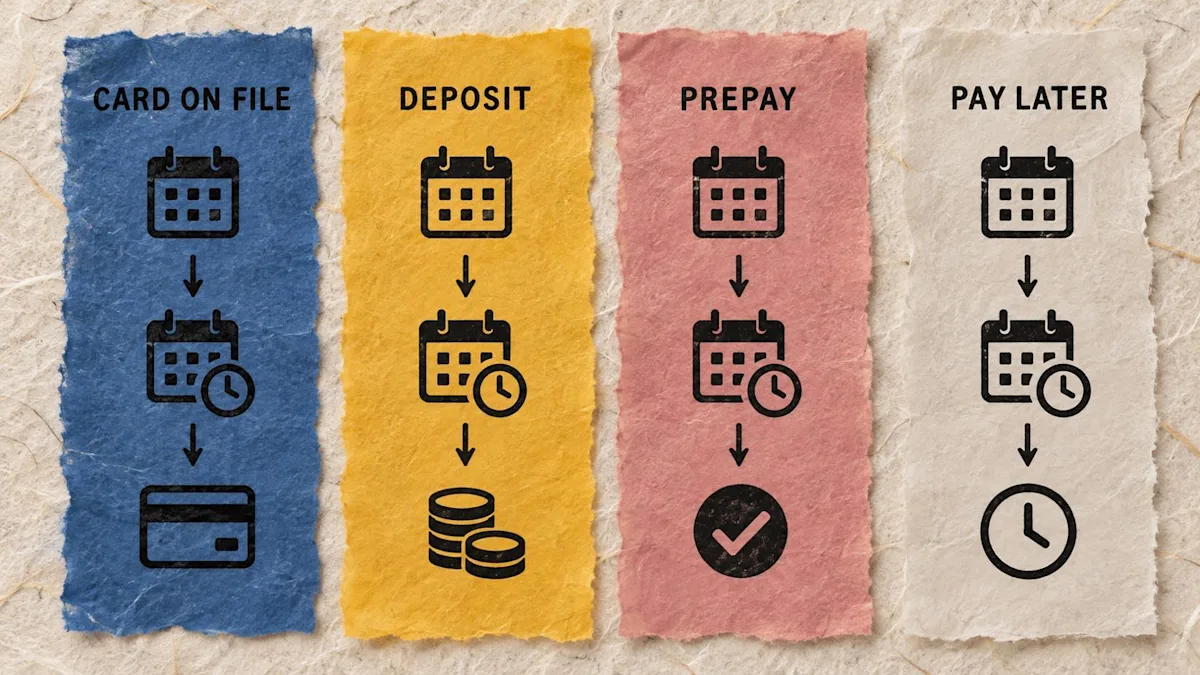
Card on file, deposit, full prepayment, and pay later protect different risks and create different client steps.
Card on file
The client authorizes a payment method to be saved for a described future use. The clinic may collect nothing at booking. Later uses might include client-authorized checkout, a remaining balance, or a fee under disclosed terms.
Saving a payment method is not permission for every future charge. Stripe's Setup Intents documentation says businesses are responsible for applicable laws and network rules and must obtain permission for the intended future use. Terms for future off-session charges should explain permission, anticipated frequency, and how the amount will be determined.
Deposit or amount paid at booking
The clinic collects part of the service price when the appointment is booked. The policy should say whether that amount is applied to the completed service and what happens after an on-time cancellation, late change, no-show, clinic cancellation, refund, or reschedule.
“Deposit” is convenient conversational language, but counsel should confirm the legally accurate label and treatment for the clinic's arrangement.
Full prepayment
The clinic collects the service price at booking. This provides the strongest immediate cash commitment but can create the most price friction and the largest refund or rescheduling workflow.
Full prepayment does not eliminate disputes. The clinic still needs clear terms, accurate service descriptions, an exception owner, and a documented refund process.
Book now, pay later
The client confirms the appointment without paying the full service price upfront. Under Workee's current workflow, an authorized payment method can be saved during booking, and the clinic can later collect the remaining balance, check out the client, send a payment link, or apply a configured no-show fee when appropriate.
This is a workflow description, not a statement that every later charge is permitted. The clinic's terms, client authorization, applicable law, and payment rules still control.
Card on file vs deposit: the practical comparison
Upfront client friction
Card on file: asks for payment details and authorization but may collect no immediate amount.
Deposit: creates an immediate charge smaller than the full service price.
Full prepayment: requires the largest upfront commitment.
Pay later without a saved method: creates the least payment friction at booking but leaves the most collection work later.
Fewer steps are not always better. A low-friction booking that regularly produces unpaid balances or weak commitment may cost more to operate. A high-friction rule that suppresses appropriate new-client consultations can also cost more than it protects.
Cash and commitment
A deposit or prepayment collects cash before the appointment. Card on file creates a potential later collection method, not cash. The relative value depends on the clinic's cancellation behavior, charge success, refund volume, staff workload, and service economics.
Do not assume a saved method guarantees collection. Issuers can decline charges, clients can dispute transactions, authentication may be required, and the charge must still be authorized and supported by the clinic's records.
Staff workflow
Deposits and prepayments require clear balance, transfer, refund, and exception handling. Card-on-file and pay-later workflows require clear checkout ownership, charge authority, payment-link fallbacks, and declined-payment handling.
The best method is not the one with the fewest visible steps on the booking page. It is the one the team can apply consistently from booking through final settlement.
Client understanding
Each mechanism needs plain-language disclosure at the decision point. Clients should not have to infer whether an amount is refundable, whether it applies to the service, when a card may be charged, or how to change an appointment.
Choose the rule with a service-tier worksheet
Do not copy one universal percentage across the menu. Complete the worksheet for each operational service tier.
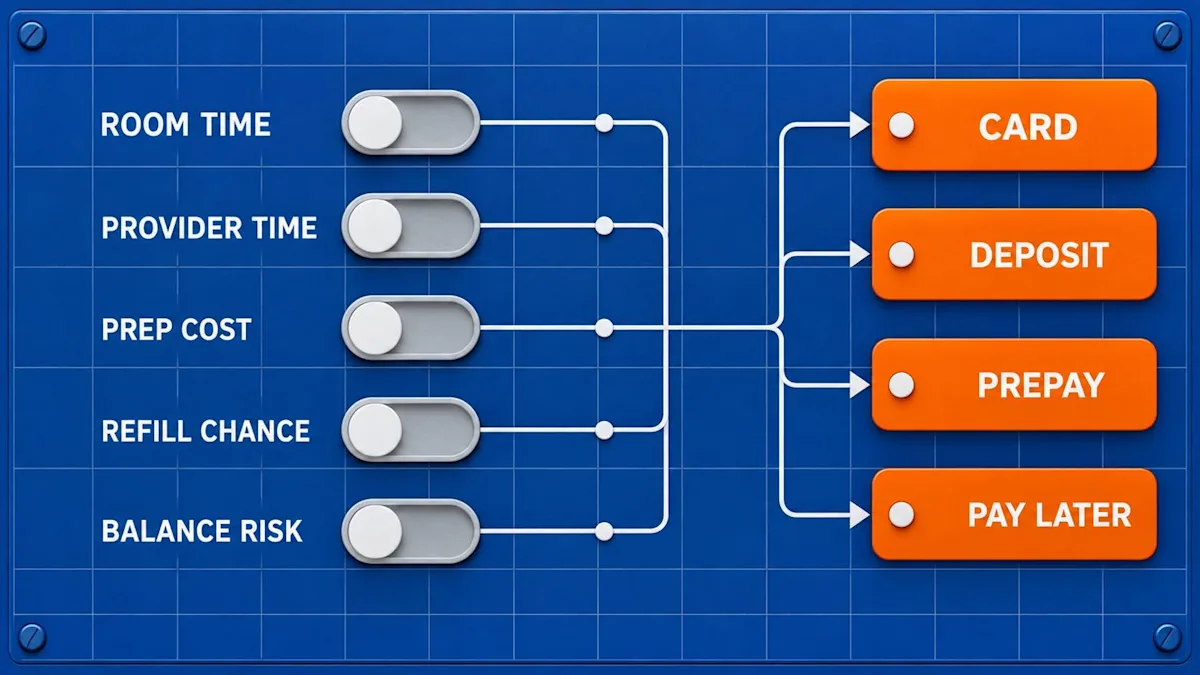
Use service facts to choose the rule, then test whether it improves completed appointments and collections.
1. Room time reserved
Record the room duration and whether that room could serve another appointment. A long exclusive reservation carries different risk from a brief consultation in flexible space.
2. Provider time reserved
Record the provider duration, scarcity, and whether another qualified provider can take the appointment. Include coordinated appointments that reserve more than one person.
3. Preparation or consumable commitment
Identify costs incurred before arrival, not general overhead. Examples might include products opened, special ordering, equipment setup, or staff preparation. Do not assume every service consumes materials before the client arrives.
4. Realistic refill chance
Estimate whether the clinic can refill the slot after the applicable notice window. Use the clinic's own waitlist and booking-history evidence. A popular evening slot and a specialized weekday appointment may have different refillability.
5. Remaining-balance risk
Consider the amount likely to remain after the visit, whether treatment scope can change, whether add-ons occur, and how checkout is handled. A deposit may still leave a significant balance; full prepayment may be impractical when the final amount is not known in advance.
6. New-client uncertainty
New prospects may need a lower-friction consultation path. That does not mean “never take a deposit.” It means the clinic should measure whether its chosen rule filters risk or simply blocks appropriate first steps.
7. Refund and dispute complexity
Choose a mechanism only after defining who can approve refunds, transfers, credits, and exceptions and what records support the decision.
A service-by-service decision pattern
The examples below are management hypotheses, not universal recommendations.
Short, easily refillable consultation
A clinic might test card on file or pay later when the consultation is brief, preparation cost is low, and the objective is reducing first-step friction. It should still use reminders, clear change instructions, and a measured response to missed appointments.
Standard recurring service
A clinic might compare card on file with a modest amount paid at booking. The decision depends on completion history, balance size, membership terms, staff checkout capacity, and client experience.
Long or multi-resource appointment
A deposit or larger prepayment may be considered when the appointment reserves scarce provider time, a room, equipment, or meaningful preparation. The amount and label should follow legal, financial, and policy review—not an industry percentage copied from another clinic.
Service with uncertain final amount
Card on file or a partial payment may fit better than full prepayment when the final authorized service and price are determined later. Staff must not charge for unapproved changes merely because a method is available.
Package, membership, or promotional booking
First identify what has already been paid, how value is allocated, and which terms apply. Do not stack a deposit, stored value, and a cancellation fee without a clear accounting and client-facing explanation.
Make the payment rule agree with the cancellation policy
The payment mechanism and the cancellation policy must agree, but they are not the same document.
The payment rule answers:
what is collected or authorized at booking;
what remains due;
how checkout works; and
what payment records are created.
The cancellation policy answers:
what counts as on time, late, missed, or rescheduled;
what happens to an amount already paid;
whether a later fee may apply;
who may approve an exception; and
what happens when the clinic causes the change.
Use Workee's med spa cancellation-policy guide to build the policy decision system. Use the no-show recovery playbook after a missed appointment has been verified. This article owns only the choice and operation of the payment mechanism.
Build a disclosure and authorization record
Before activating a workflow, document:
the payment mechanism and client-facing label;
the amount or method used to determine it;
when the payment method may be saved;
the specific future uses the client authorizes;
when an amount is charged;
what happens after cancellation, rescheduling, no-show, clinic cancellation, refund, or charge failure;
how the client can obtain the terms;
the version of the terms shown at booking;
the client's acknowledgment or authorization record; and
the staff member responsible for exceptions.
Stripe's guidance on saving a payment method during payment recommends explaining how payment details will be saved, collecting permission for the intended future use, and keeping a record of the agreement. The clinic should have its own counsel and payment provider adapt the implementation.
Avoid a vague checkbox such as “I agree to all policies” when the material payment action is hidden elsewhere. Plain language should identify what happens now and what may happen later.
Map the appointment payment workflow
Write one operating sequence for each service tier:
Client chooses the service and time.
The booking page shows the applicable payment rule and policy.
The client provides the required payment or authorization.
Confirmation states what was paid, what remains, and how to change the booking.
Reminders repeat the relevant change path without threatening language.
At the appointment, staff verify the delivered service and authorized amount.
Checkout collects the approved remaining balance or sends a payment link.
Any refund, exception, fee, or failed charge follows the documented owner path.
The transaction record includes charges, deposits, tips, refunds, dates, and statuses.
Returning clients may move faster when a saved method can be securely verified. Workee's current update says an SMS security code is used when a saved payment method is available for a returning client's booking. Do not describe that convenience as permission for unrelated charges.
Measure whether the rule actually works
Compare payment rules by service tier over equivalent periods. Track counts and rates for:
booking starts and completed bookings;
amount collected at booking;
cancellations and no-shows under the clinic's definitions;
completed appointments;
remaining balances collected at checkout;
payment links sent and completed;
refunds, exceptions, failed charges, and disputes;
staff minutes spent on collection and exceptions; and
new-client consultation completion.
Segment by service, client type, booking horizon, channel, and location when the sample is large enough to be useful. A rule may improve one metric while harming another. For example, stronger upfront commitment may reduce booking completion, while lower friction may increase staff collection work.
Choose a decision period before launch. Do not change terms every week in response to a few events. Also do not let a policy continue indefinitely when the clinic cannot explain its booking, completion, collection, and dispute outcomes.
Common mistakes
Applying the same deposit to every service
This ignores differences in time, preparation, price uncertainty, and refillability.
Treating a saved card as guaranteed payment
Authorization scope, declines, authentication, disputes, and legal requirements still matter.
Hiding the later charge
Clients need clear terms at the decision point. A staff script after the event cannot repair a hidden booking disclosure.
Measuring only no-shows
Also measure booking completion, completed appointments, checkout collection, refunds, disputes, and staff time.
Letting every employee approve exceptions
Define an owner and recorded reason codes. Consistency protects both the client experience and the clinic's ability to learn.
Using old product instructions as current policy
Product capabilities and plan details change. Use current Workee settings and support materials, not an older blog screenshot, to configure the workflow.
How Workee supports card-on-file and deposit workflows
Workee's current payment experience supports amounts paid at booking, saved-payment verification for returning clients, Book Now Pay Later, remaining-balance visibility, checkout from the appointment page, payment links, configured no-show fees when appropriate, refunds, receipts, and a transaction activity view.
Those capabilities connect the payment record to the appointment. They do not replace the clinic's policy design, legal review, authorization language, clinical consent, accounting, or staff decisions.
See Workee's current payments and invoicing tools and medical spa platform for the product workflow.
The decision rule
Start with the least restrictive mechanism that covers the service's documented operational risk. Test it against completed bookings, completed visits, collected balances, exceptions, disputes, and client friction. Increase or reduce the commitment only when the service-level evidence supports the change.
The right rule is the least restrictive mechanism that reliably protects the service's real operational risk.
Ready to configure a connected booking and payment workflow? Explore Workee payments and invoicing or schedule a demo with the Workee team.



Keep updated about latest industry insights and subscribe to our newsletter
Follow Us


